
Search Questions
Search


Q: .
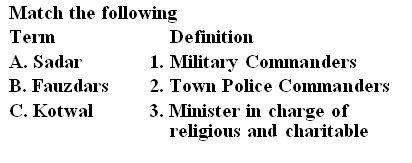
- A. A–1, B–2, C–3
- B. A–1, B–3, C–2
- C. A–3, B–1, C–2
- D. A–2, B–1, C–3
Correct Answer:
Option C - The Emperor of the Mughal Empire was always the central administrative authority. A number of officers in the different governmental departments were appointed for the smooth functioning of transactions involving various affairs. They are as follows.
Officials and their departments
1. Sadar – The head of religious donations
and contributions.
2. Fauzdar – Executive and military officer in
each district
3. Kotwal – Chief of the city Police
4. Subedar – Governor of the Suba
(Sipah-Salar)
5. Diwan – Incharge of revenue
administration of the province.
6. Quanungo – Head of village patwaris.
C. The Emperor of the Mughal Empire was always the central administrative authority. A number of officers in the different governmental departments were appointed for the smooth functioning of transactions involving various affairs. They are as follows.
Officials and their departments
1. Sadar – The head of religious donations
and contributions.
2. Fauzdar – Executive and military officer in
each district
3. Kotwal – Chief of the city Police
4. Subedar – Governor of the Suba
(Sipah-Salar)
5. Diwan – Incharge of revenue
administration of the province.
6. Quanungo – Head of village patwaris.
Explanations:
The Emperor of the Mughal Empire was always the central administrative authority. A number of officers in the different governmental departments were appointed for the smooth functioning of transactions involving various affairs. They are as follows. Officials and their departments 1. Sadar – The head of religious donations and contributions. 2. Fauzdar – Executive and military officer in each district 3. Kotwal – Chief of the city Police 4. Subedar – Governor of the Suba (Sipah-Salar) 5. Diwan – Incharge of revenue administration of the province. 6. Quanungo – Head of village patwaris.Address
12, Church Ln, The Adelphi, Allen Ganj, Prayagraj, Uttar Pradesh 211002
+91 9554973128
info.yctbooks@gmail.com
Download Our App